Google Pixel 8a Full Specifications: Is It the Ultimate Mid-Range AI Phone?
Introduction
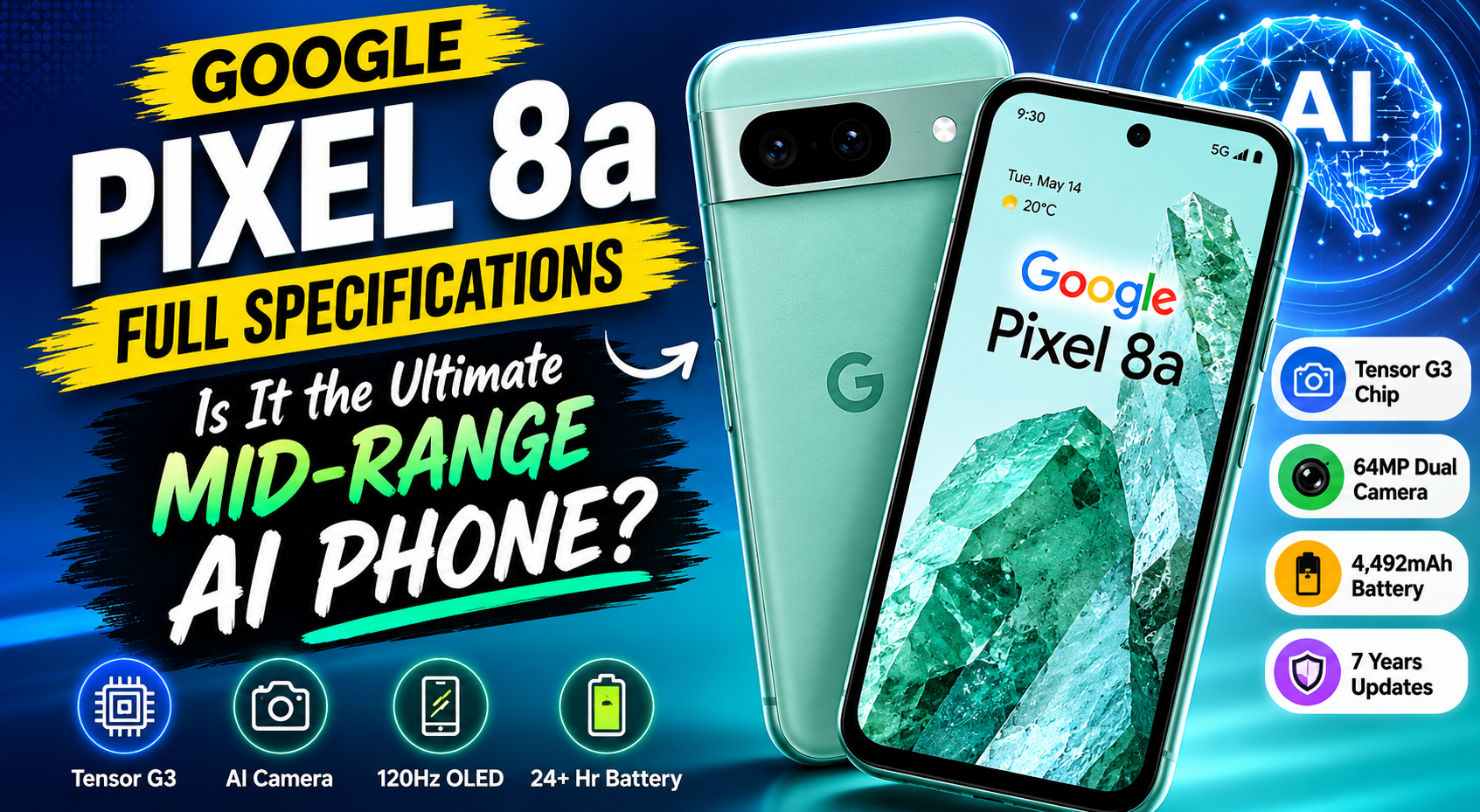
The Google Pixel 8a is one of those phones that looks modest on paper but gets louder the more you use it. At $499 at launch, Google positioned it as a cheaper way to get the same core Pixel magic found in its flagship phones: Tensor G3 performance, flagship-style AI tools, and seven years of software support. That combination is exactly why the Pixel 8a became such a serious mid-range contender.
What makes this phone especially interesting is not just the hardware, but the experience around it. Google did not try to win the spec war with the biggest battery, the fastest charging, or a telephoto camera. Instead, it focused on the things people actually notice every day: a bright display, strong photos, helpful AI features, reliable security, and long-term updates. That is the real Pixel 8a story.
Read More – Sony Xperia 1 VI Review: Is It Still the Best Phone for Pro Photographers in 2026?
Google Pixel 8a full specifications at a glance
| Category | Google Pixel 8a |
|---|---|
| Display | 6.1-inch Actua OLED, 1080 x 2400, 430 PPI, up to 120Hz, up to 2,000 nits peak brightness |
| Processor | Google Tensor G3 with Titan M2 security coprocessor |
| RAM | 8GB LPDDR5x |
| Storage | 128GB / 256GB UFS 3.1 |
| Rear cameras | 64MP wide + 13MP ultrawide, with Super Res Zoom up to 8x |
| Front camera | 13MP selfie camera |
| Battery | 4,492mAh typical, 24+ hour battery life, up to 72 hours with Extreme Battery Saver |
| Charging | Fast charging, Qi-certified wireless charging |
| Protection | IP67 dust and water resistance |
| Software support | 7 years of OS, security, and Pixel Drop updates |
| Colors | Obsidian, Porcelain, Bay, Aloe |
Why the Google Pixel 8a feels more premium than its price
The first thing you notice about the Google Pixel 8a is the display. It is a 6.1-inch OLED panel with a 120Hz refresh rate and peak brightness up to 2,000 nits, which makes it much easier to use outdoors than older mid-range phones. Google also gives it Always-on Display support, HDR, and a high-contrast panel that feels closer to a flagship than a budget device.
Design is another area where the Pixel 8a punches above its price. Google uses an aluminum frame, Gorilla Glass 3 on the front, and a matte composite back. Reviewers repeatedly noted that the phone feels comfortable in hand, with rounded edges and a refined camera bar that gives it a premium identity, even if the bezels are thicker than on the Pixel 8.
That last part matters because the Pixel 8a is not trying to look like a “cheap Pixel.” It is trying to look like a compact, practical phone that happens to cost far less than the flagship. That is a very different design philosophy, and it works.
The AI story: where the Pixel 8a really earns its name
If you are buying the Pixel 8a for AI, this is where it becomes compelling. Google says the phone includes many of the same AI features as the Pixel 8 and Pixel 8 Pro, including Gemini, Best Take, Magic Editor, and Audio Magic Eraser. Those tools are not gimmicks; they solve real problems like rescuing group photos, cleaning noisy video, and editing pictures with a few taps.
The official feature set is broader than people expect from a mid-range phone. Google includes Camera Coach, Add Me, Real Tone, Magic Eraser, Best Take, Photo Unblur, and editing tools like Reimagine and automatic subject resizing. In everyday use, that means the Pixel 8a behaves less like a “value phone” and more like a smart assistant in your pocket.
This is why the phrase “mid-range AI phone” fits so well. The Tensor G3 does not win raw performance contests, but it enables the software features that define the Pixel experience. Reviewers from WIRED and Engadget both emphasized that the 8a’s value comes from this blend of hardware and software, not benchmark bragging rights.
Camera performance: still the Pixel advantage
The camera hardware is simple, but that simplicity is part of the appeal. The Pixel 8a uses a 64MP wide camera, a 13MP ultrawide camera, and a 13MP selfie camera. It can shoot 4K video on the rear camera and 4K on the front camera as well, while offering Super Res Zoom up to 8x.
On paper, it does not look like a spec monster. In practice, Google’s processing gives it a much stronger personality. The Guardian described the Pixel 8a’s main camera as excellent across lighting conditions and highlighted Google’s strength in difficult scenes such as high-contrast shots and fast-moving subjects. Engadget also noted that the phone can compete surprisingly well, even against much more expensive rivals in daylight.
The real trick is that the Pixel 8a does not need a telephoto camera to feel complete for most buyers. Google’s computational photography, Night Sight, Astrophotography, Best Take, and Magic Editor cover the gaps for many casual users. That is why the Pixel line keeps winning over people who care more about results than camera counts.
Battery life and charging: good endurance, average speed
Battery life is one of the Pixel 8a’s stronger practical points. Google rates it for 24+ hours of battery life, with up to 72 hours using Extreme Battery Saver. The 4,492mAh battery is not huge by modern standards, but the phone still aims to deliver a full day comfortably.
Where the phone is less exciting is charging. Reviewers repeatedly pointed out that charging is slower than on many rivals. Engadget described wired charging as capped at 18W in practice and wireless charging as fairly slow, which means the Pixel 8a is best for overnight charging rather than quick top-ups. WIRED also called out charging as one of the compromises that helps Google keep the price down.
That is a fair trade if you care more about the whole-phone experience than a race to 100 percent. But for users who rely heavily on fast charging, this is one of the first places the Pixel 8a feels clearly mid-range.
Google Pixel 8a vs Pixel 7a vs Pixel 8
| Feature | Pixel 8a | Pixel 7a | Pixel 8 |
|---|---|---|---|
| Display | 6.1-inch, 120Hz, 2,000 nits peak | 6.1-inch, up to 90Hz | 6.2-inch, 120Hz, 2,000 nits peak |
| Chip | Tensor G3 | Tensor G2 | Tensor G3 |
| Main camera | 64MP wide | 64MP wide | 50MP wide |
| Battery | 4,492mAh typical | 4,385mAh typical | 4,575mAh typical |
| Storage options | 128GB / 256GB | 128GB only | 128GB / 256GB |
| Software support | 7 years | 7 years | 7 years |
This table shows the Pixel 8a’s real advantage: it keeps the most important Pixel strengths while trimming the expensive extras. Compared with the Pixel 7a, the 8a gets a faster Tensor G3 chip, a brighter 120Hz display, and more storage flexibility. Compared with the Pixel 8, it gives up some polish and premium materials, but keeps the same core AI identity and the same long software commitment.
What the Pixel 8a gets right
The Pixel 8a gets a lot right for its price. It has a flagship-grade AI experience, excellent cameras, a bright display, solid battery life, and one of the best update promises in the entire mid-range category. That is why multiple reviewers called it one of the best mid-range Android phones available.
It also has a clear identity. Some mid-range phones try to win by stuffing in every possible spec. The Pixel 8a wins by being coherent. It is compact, smart, camera-focused, and software-first. For many buyers, that is a much more useful formula than raw numbers on a spec sheet.
Where the Pixel 8a still compromises
The compromises are real. The plastic back is less premium than glass, the bezels are thicker than on the Pixel 8, water resistance is IP67 instead of IP68, and charging is not especially fast. Those are not dealbreakers, but they are worth knowing before you buy.
There is also the bigger strategic question: by the time you shop for the Pixel 8a, it may sit uncomfortably close in price to newer Pixel models or heavily discounted flagships. That is exactly why its value depends on local pricing and sales. At launch, though, the formula made perfect sense.
Final verdict: is the Google Pixel 8a the ultimate mid-range AI phone?
Yes, with a small asterisk. The Google Pixel 8a is one of the strongest mid-range phones Google has ever made because it focuses on the right things: smart AI features, dependable cameras, a bright 120Hz display, and long-term updates. For people who want the Pixel experience without paying flagship money, it is extremely easy to recommend.
But “ultimate” depends on what you value most. If you want the fastest charging, a telephoto camera, or a more premium build, the Pixel 8 or another higher-tier phone may be a better fit. If you want the best balance of intelligence, camera quality, and value, the Pixel 8a is still one of the smartest buys in the mid-range market.
CTA
Have you used the Google Pixel 8a or are you planning to buy one? Share your thoughts, and check out your related Pixel guides next to help readers compare the 8a with the Pixel 8 and Pixel 9a.