

Sony Xperia 10 VI Review: Product Info, Full Specs & Worth Buying in 2026?
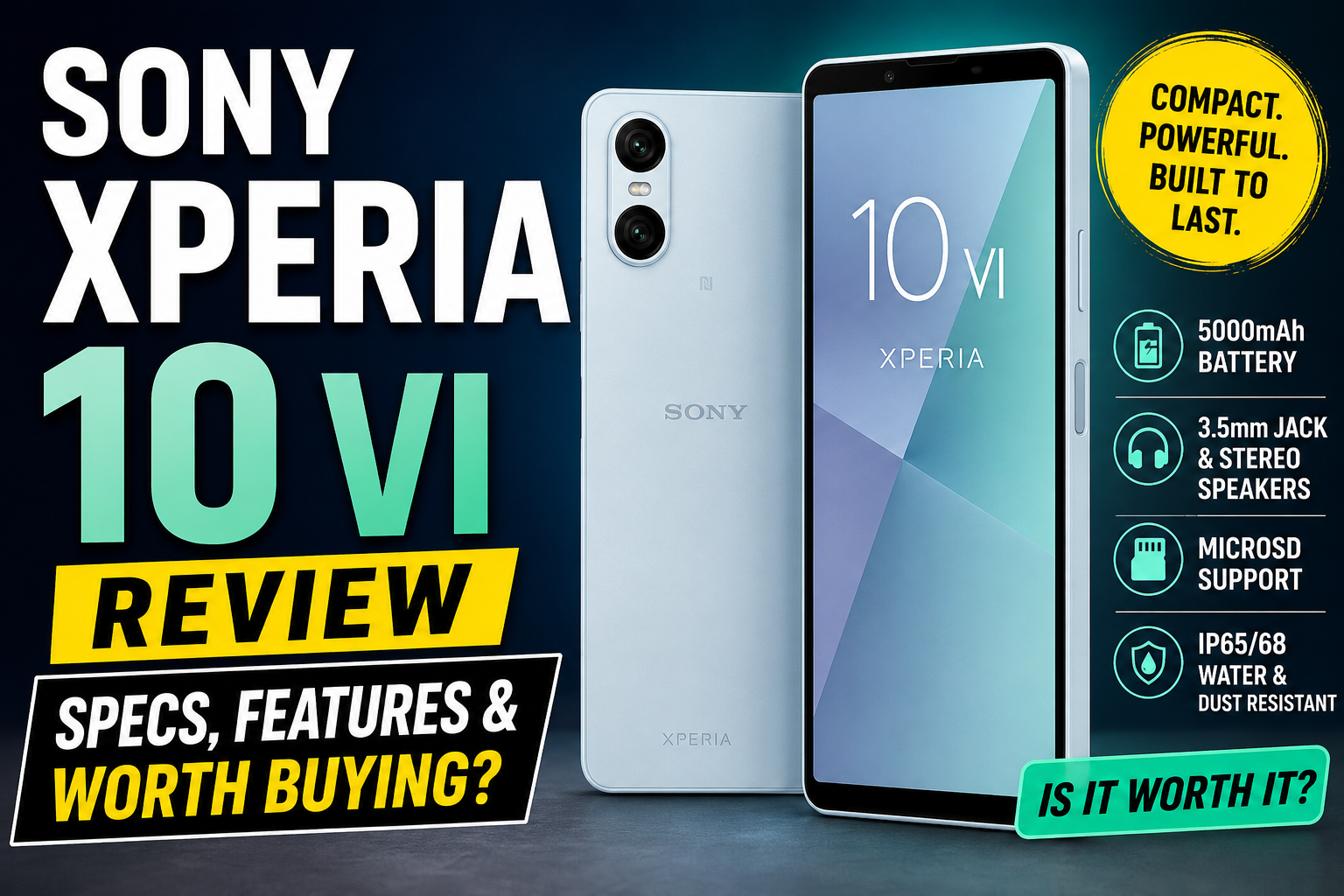
The Sony Xperia 10 VI is one of the rare mid-range phones that does not try to win the spec race. Instead, Sony doubles down on a compact body, a tall 21:9 display, a huge battery, a headphone jack, and microSD support. That makes it feel less like a “mainstream all-rounder” and more like a deliberate choice for people who value comfort, media, and longevity. Sony launched it in May 2024, and the phone ships with Android 14, a 5,000 mAh battery claim, and a lighter 164 g build.
Sony Xperia 10 VI at a glance
| Spec | Sony Xperia 10 VI |
|---|---|
| Display | 6.1-inch 21:9 FHD+ OLED, 60Hz refresh rate, 120Hz touch scanning |
| Size & weight | 155 x 68 x 8.3 mm, 164 g |
| Processor | Snapdragon 6 Gen 1 |
| RAM / Storage | 8 GB RAM, 128 GB storage |
| Storage expansion | microSDXC support up to 1.5 TB |
| Battery | 5,000 mAh, USB Power Delivery fast charging, Xperia Adaptive Charging, Battery Care, STAMINA Mode |
| Rear cameras | 48 MP main + 8 MP ultrawide; no dedicated telephoto lens |
| Front camera | 8 MP |
| Audio | 3.5 mm jack, front stereo speakers, LDAC, aptX Adaptive |
| Durability | IPX5/IPX8 water resistance, IP6X dust proof, Gorilla Glass Victus |
| Software support | Android 14 with 3 OS upgrades and 4 years of security updates; Sony’s business support page lists security support through June 2028 and future Android 15 support. |
What the Xperia 10 VI gets right
1) It is genuinely comfortable to hold
Most phones in 2026 still chase bigger screens and wider bodies, but the Xperia 10 VI keeps the old Sony formula alive: slim, narrow, and easy to use one-handed. At 68 mm wide and 164 g, it is noticeably lighter than many mid-range rivals, and Sony explicitly positions it as a comfort-first device. Notebookcheck also describes it as “small and handy,” which matches the overall design goal.
That matters more than many spec sheets admit. A phone can have a great display and still feel annoying in daily use if it is too wide or too heavy. The Xperia 10 VI’s shape makes it easier to pocket, easier to grip, and less tiring for long scrolling sessions. That is a real advantage if you read, stream, or browse a lot on your phone. This is an inference from Sony’s design choices and the hands-on review consensus.
2) The battery is the headline feature
Sony says the Xperia 10 VI is built for “two-day use,” and the official press release emphasizes a large-capacity battery and improved endurance over the previous model. Independent reviews back that up: Notebookcheck calls its battery life “very long,” and other review outlets echo the same message.
This is the kind of phone that rewards boring habits in the best way. You can leave the charger at home more often, and Sony’s battery-care tools are designed to slow down battery wear over time. In other words, the Xperia 10 VI is not just about surviving today; it is about staying healthy for longer. Sony explicitly says the battery stays healthy for three years thanks to its charging technologies.
3) Sony kept the useful enthusiast features
A lot of modern mid-rangers have quietly stripped away the extras that power users care about. Sony went the other way. The Xperia 10 VI still includes a 3.5 mm headphone jack, microSD expansion, front stereo speakers, NFC, and Hi-Res audio support. Notebookcheck specifically highlights these features as part of what makes the phone unusual in the mid-range segment.
That combination is rare enough to matter. If you still use wired headphones, carry a large offline media library, or want a phone that can serve as a portable music device, Sony is speaking your language here. What Hi-Fi’s review also frames the 10 VI as especially appealing for movies and music, even while criticizing the camera side of the package.
4) Software support is better than Sony’s older mid-rangers
This is an important upgrade that people often miss. The Xperia 10 VI ships with Android 14 and promises 3 OS upgrades plus 4 years of security updates. Sony’s business support page lists security support for the Xperia 10 VI through June 2028, with future Android 15 support. By contrast, the Xperia 10 V shipped with Android 13 and received only 2 OS upgrades and 3 years of security updates.
That makes the 10 VI more sensible as a long-term buy than earlier Xperia 10 models. For a mid-range phone, that extra year of support can matter more than a marginally faster charger or a flashy spec on a brochure.
Where the Xperia 10 VI falls short
1) The screen is still only 60Hz
Sony kept the same 6.1-inch, 21:9 OLED idea, but the refresh rate remains 60Hz. The touch sampling is 120Hz, but the panel itself does not move to the 90Hz or 120Hz standard that many rivals now offer. Samsung’s Galaxy A55, for example, has a 6.6-inch Super AMOLED display with up to 120Hz adaptive refresh.
That means scrolling, animation, and general fluidity are less impressive than the rest of the market at this price. This is not a deal-breaker for everyone, but it is the clearest place where Sony looks stubborn rather than clever.
2) Sony removed the telephoto camera
The Xperia 10 V used three rear cameras, including a telephoto lens. The Xperia 10 VI drops that lens and goes back to a dual-camera setup with a 48 MP main sensor and an 8 MP ultrawide camera. What Hi-Fi explicitly notes that Sony removed the 8 MP telephoto lens, and Sony’s own specs confirm the new two-camera layout.
Sony argues the high-resolution main camera can handle zoom duties through its hybrid zoom and AI Super Resolution Zoom features, but the trade-off is still real: you lose optical flexibility. If you care about portraits, distant subjects, or cleaner zoom shots, this is a step backward on paper.
3) Performance is decent, not exciting
The Snapdragon 6 Gen 1 is a meaningful improvement over the Snapdragon 695 used in the Xperia 10 V, and review sites note the phone feels less stuttery than the older model. Still, it is very much a mid-range chip, not a speed monster. Notebookcheck and What Hi-Fi both frame the 10 VI as a practical phone rather than a performance leader.
If your day includes lots of gaming, heavy multitasking, or demanding camera editing, the Xperia 10 VI is not trying to win that audience. It is trying to be efficient, light, and dependable. That is a valid strategy, but it narrows the appeal.
4) The USB port is still basic
Notebookcheck points out that Sony still uses USB 2.0 on the Xperia 10 VI, which makes file transfers relatively slow by modern standards. In a phone that otherwise feels media-friendly, that is a frustrating holdover.
Xperia 10 VI vs Xperia 10 V vs Galaxy A55
| Feature | Xperia 10 VI | Xperia 10 V | Galaxy A55 |
|---|---|---|---|
| Display | 6.1-inch 21:9 OLED, 60Hz | 6.1-inch 21:9 OLED, 60Hz | 6.6-inch Super AMOLED, up to 120Hz |
| Chipset | Snapdragon 6 Gen 1 | Snapdragon 695 5G | Exynos 1480, per Samsung product page for the A55 5G. |
| RAM | 8 GB | 8 GB | Varies by market; Samsung lists multiple memory options on the product page. |
| Battery | 5,000 mAh | 5,000 mAh | 5,000 mAh and 25W charging. |
| Camera setup | 48 MP + 8 MP, no telephoto | 48 MP + 8 MP + 8 MP telephoto | Triple-camera setup with a 50 MP main camera. |
The comparison tells the story clearly: the Xperia 10 VI is not the most spec-rich phone here, but it is the smallest and most Sony-like. The Galaxy A55 is the more mainstream value pick if you want a smoother screen and a stronger all-round package. The Xperia 10 V remains interesting only if you find it much cheaper, because the 10 VI adds better performance and longer support.
So, is the Sony Xperia 10 VI worth buying?
Yes, but only for a very specific kind of buyer. The Xperia 10 VI is worth buying if you want a light, compact phone with a headphone jack, microSD support, excellent battery life, and a cleaner long-term software commitment than Sony’s older mid-range models. That is the core of its appeal, and the reviews consistently praise those strengths.
It is not the best choice if you care most about silky scrolling, top-tier cameras, or raw speed. The 60Hz display, missing telephoto camera, and modest chipset make it feel intentionally old-school in a market that has moved on. That does not make it bad; it makes it specialized.
My verdict: the Sony Xperia 10 VI is a smart buy for practical users, media lovers, and Sony loyalists. For everyone else, a phone like the Galaxy A55 will probably feel more modern day to day.
Final takeaway
The Sony Xperia 10 VI succeeds by refusing to follow the crowd. It is slim, light, long-lasting, and refreshingly practical, with a feature set that still respects people who care about wired audio and expandable storage. The trade-off is that Sony has left some modern conveniences behind, especially a high-refresh-rate screen and a more versatile camera system. That makes the Xperia 10 VI a thoughtful niche phone, not a universal recommendation.
CTA: Have you used a Sony Xperia phone before, or are you considering the Xperia 10 VI for battery life and compact design? Share your thoughts in the comments and check your related Sony comparison posts next.Share your thoughts in the comments and check your related Sony comparison posts next.
